


For more than a decade, US companies have relied on outsourcing
to scale engineering. The model served its purpose—lower cost, faster hiring,
task-based execution. But in 2026, a clear shift is unfolding: companies are
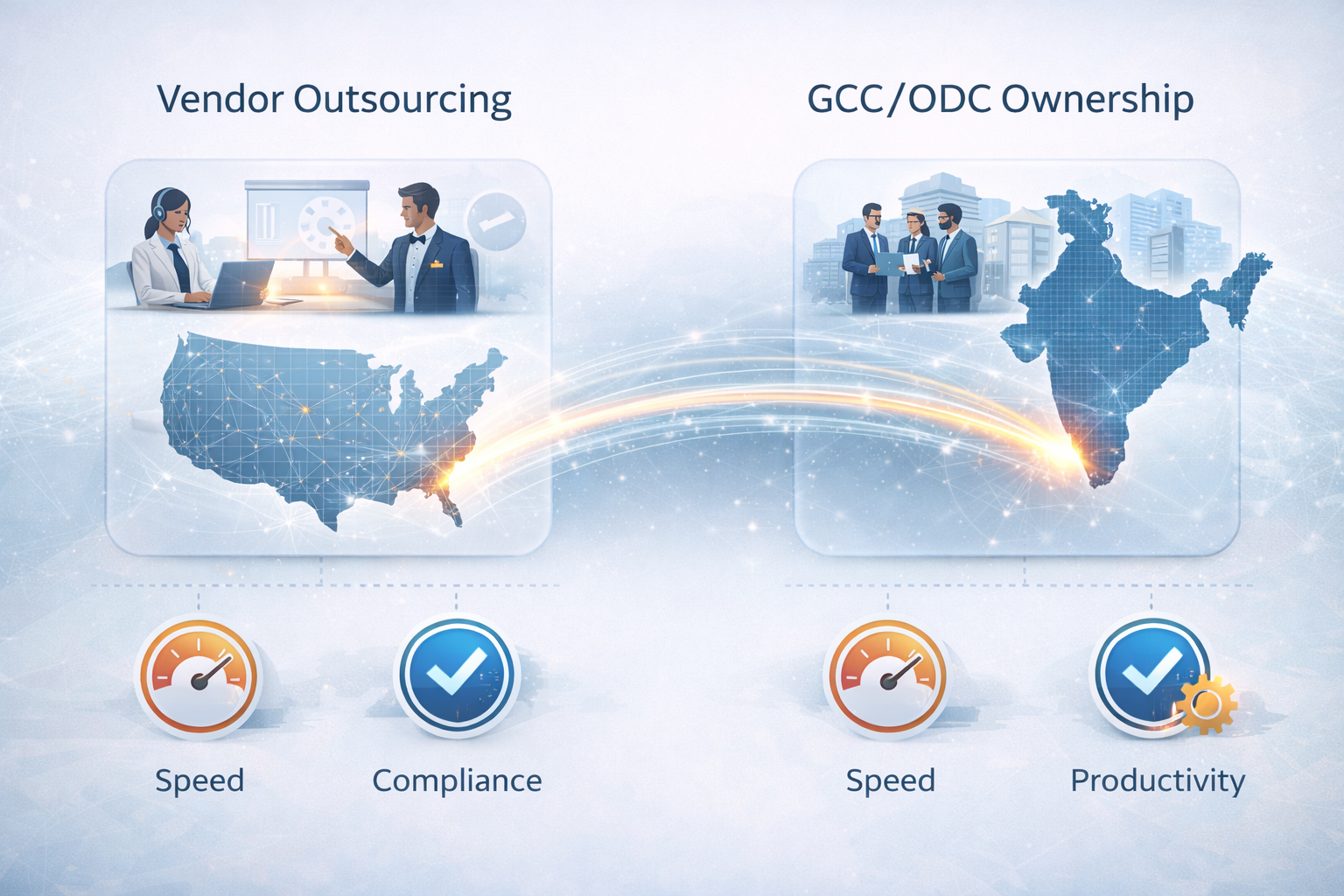
moving from outsourcing to building GCCs (Global Capability Centers) in India.
This shift is not driven by cost.
It is driven by capability, ownership, compliance, and velocity.
1. Why Outsourcing Is a Losing Fit for Modern Product Development
Product companies today operate with:
- Agile cycles are released weekly
- Complex integrations
- Real-time systems
- Rapid shifts in market needs
- High expectations on security and compliance
Outsourced teams struggle with:
- Lack of product ownership
- Ticket-based delivery
- Shallow domain immersion
- Slow feedback loops
- High dependency on coordination
When innovation cycles shrink, the vendor model slows Companies down.
2. GCCs Create Ownership, Proximity, and Strategic
Alignment
A GCC behaves like an extension of the core product team. It is not a vendor. It is your own team, operating from India.
Benefits include:
- Full-time engineers embedded in product thinking
- Leadership alignment across engineering + product
- Ability to scale to 50, 100, 200+ engineers
- Consistent engineering culture
- Predictable long-term velocity
This is why companies in healthcare, SaaS, logistics, and retail are adopting the model aggressively.
3. India Has Become the Global Engineering Capital
India now offers:
- The largest engineering talent pool in the world
- Deep expertise in AI, cloud, mobility, DevOps, and platform engineering
- Leadership-level capability for product roles
- Mature compliance and security frameworks
Companies that once worked with 1–2 vendors are now setting
up their own dedicated GCCs in India to secure a long-term talent advantage.
4. Healthcare, Logistics, Retail, EdTech Are Leading the
Adoption
Industries with heavy compliance, data sensitivity, and
Rapid evolutions are accelerating GCC adoption:
- Healthcare → PHI security, telehealth, EHR modernization
- Logistics → IoT pipelines, real-time tracking
- Retail → composable commerce, AI-driven personalization
- Education → adaptive learning systems
A GCC offers strategic depth that outsourcing simply cannot.
5. The GCC Playbook for 2026
Companies building GCCs successfully follow 5 steps:
- Define engineering vision & capability roadmap
- Set up leadership pods + team pods
- Establish governance, metrics, and product alignment
- Implement a strong DevOps + security foundation
- Scale with repeatable hiring + KT frameworks
Resilience InfoTech has deployed this model for multiple US
Companies—one scaling from 6 to 150+ engineers in under two years.
Conclusion
The shift from outsourcing to GCCs is not a trend—it is a
fundamental upgrade in how engineering organizations scale.
Companies who adopt it early will gain an advantage in speed, capability,
and product maturity
Add a Comment